Most schools in America are at (or near) the midway point of the school year. As such, it tends often to be a difficult time for motivation – both for kids and teachers. We are far enough into the school year to be sufficiently exhausted, yet too far away from the end of the year to be motivated by the finish line. If we are being honest, its also the time of the year when many educators can fall into the trap of complaining about students and their deficits in motivation, academic achievement or behavior.
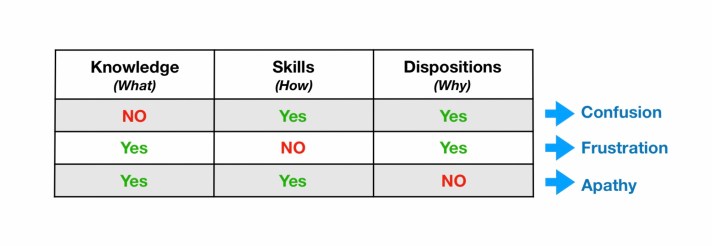
On a school visit a couple of years ago I was speaking with Joe Erpelding, principal of Design 39 in Poway, California who shared something similar to the chart above. We were discussing some of the most common student challenges that we see, and what (if anything) we could do to address them. I love this chart for three reasons: (1) it is dead simple to use; (2) it highlights how important knowledge, skills and dispositions are for learning. I don’t think students can effectively learn when they are missing any of the big three. (3) these are probably the three most common challenges teachers see regularly in the classroom, so the chart is applicable with any age group.
Let’s take a quick look at these three common scenarios in a bit more detail . . .
The Confused Student:
Generally speaking, the confused student is suffering from a lack of knowledge. He or she may have the skills needed to accomplish a given task (say the ability to think critically, to collaborate, or to communicate effectively), and they may also have an understanding of why that learning is important. However, without appropriate content knowledge, they will be confused about what to actually do. I think that this is incredibly important to remember in an era where more and more schools are focusing on soft skills and student voice in the learning process. While I would argue that both of these elements are critical to student engagement and relevancy, we can’t forget that students also need foundational knowledge.
Students who can’t read effectively, or who don’t have mastery of basic math facts, will generally struggle in more complicated tasks. As I often tell families at my school, “you can’t learn to read through project based learning, and you can’t engage in project based learning if you can’t read.” On the flip side, we can also make the mistake of assuming all content knowledge learning is “essential” for students to know. This, in many ways, is as big a mistake as overlooking content altogether. Especially in an an era where student have access to infinite information through their smartphones, we need to be critical about what really matters. The key is to find the balance between the two, and to critically assess whether what we are covering is truly necessary.
The Frustrated Student:
The frustrated student often has a strong background in content knowledge and foundational skills. In fact, he/she may generally be very successful in the traditional compliance model seen in most schools. They memorize information, regurgitate facts and read and write effectively. They probably also have an understanding of why their learning is important and how it tracks to something greater down the road. Often times, the frustrated student is disguised as another type of student: the “good student.”
While focusing intently on knowledge, many schools forget to work with students on developing critical skills for being an effective learner. Often, these skills are referred to as “soft skills” and may include things such as the ability to collaborate with others, the ability to communicate information, the ability to manage timelines effectively, and the like. Incidentally, many of these skills are regularly cited as the most critically necessary skills employers are looking for when hiring – yet few schools effectively build these skills with students.
For the frustrated student, the experience of school can often be like going on a road trip with no map. You know where you are and where you want to go, but you lack the tools and the route to get there. This is why it is critical to provide students regular opportunities to grapple with real-world tasks, and to do so collaboratively. These experiences provide students opportunities to apply content knowledge in meaningful ways, and to develop the skills necessary to do so. Furthermore, it provides opportunity for students to develop the skillsets they will need once they enter the world of work.
The Apathetic Student:
This is the type of student that seems to be on the rise, particularly during this time of the school year. The student can often seem like a student who lacks motivation, and indeed that may be the case. Often, however, apathy is something that creeps in over time – even for generally motivated kids. Sometimes these students seem to be much more motivated at the start of the year, but tend to trail-off around Thanksgiving Break or Winter Break. They seem to know the information and have the skills to be successful, yet they lack the motivation to follow-through.
Many educators will be tricked into thinking that this student is simply “lazy.” After all, doing so has it’s advantages – namely that the student is responsible for the shortcoming, not the educators. More often than not, I think the issue is actually one of value. Students in this camp tend not to see the value in what they are doing or how it connects to their daily life. The rationale of school being important because it will “help you get into college and get a good job” is no longer accurate or motivating to our kids, especially these kids. Instead, we need to help students find the why of their learning. Like in the case of the frustrated student, I think this can be addressed by connecting student learning to real-world problems and through the creation of public-facing work. In addition to engaging in real-world problems for authentic audiences, students in this group will also benefit from participating with professionals and businesses in the community to see how school translates to the world of work.
Final thoughts:
Students are nuanced and unique, and no chart (no matter how complex) will effectively identify the needs of each learner. However, I think the power of this chart lies in its ability to help us reflect on elements of our practice that might be impacting students in a negative way. We can’t change everything, but perhaps we can change something. Maybe that is just what our students need.


 A.Nelson