The community I work in has been having an identity crisis. Recent events involving students in the community have rightly triggered important emotions that have led to a reckoning that many of us didn’t see coming – but probably should have. Our community is grappling with the fact that we aren’t yet the community we aspire to be. Similarly, I find that many schools face similar challenges – they know who they want to be but they struggle with realizing that aspiration.
With the near constant fixation districts and schools have on academic achievement, one area that tends to often get overlooked is the impact of school culture and community. Since the COVID Pandemic there has been more focus on student mental health, connectedness and how schools can create cultures on campus that emphasize the two. Despite that, few schools (and even fewer students) are experiencing true community. Though the pandemic likely didn’t entirely create the problems we now see, it certainly shined a light on something that was already lurking beneath the surface.
I was recently reading the book Adrift: American in 100 Charts by Scott Galloway (2022). The book is a fascinating snapshot of America in flux, with snapshots of key data points woven together to paint what is arguably the most accurate picture of where stand as a nation. As I flipped through the pages, one chart stopped me in my tracks.
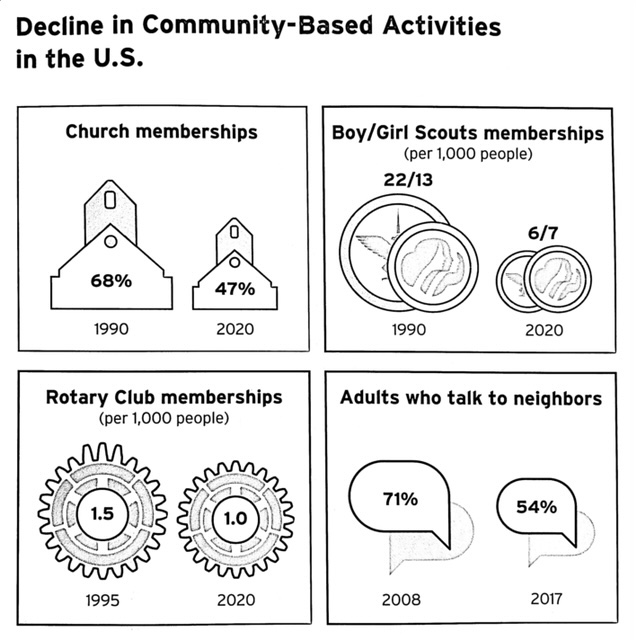
It’s no secret that challenging and disruptive behavior is on the rise in schools – with most educators reporting a marked increase in the frequency and intensity of problematic behavior. As with any problem, there are no shortage of explanations – increased isolation, screentime, social media, over indexing in “gentle parenting,” etc. I’m sure that the answer is probably a combination of many factors. Difficult problems usually are.
Occam’s Razor is a principle of theory construction that advises selecting the most simple solution when multiple hypotheses explain the same evidence. In more basic terms, it is the principle that the most simple solution to a problem is usually the best one. As the chart above suggests, the answer to what ails us as a nation may be simply that we’ve lost our appetite for, and exposure to, community. For our students, the issue is even more grave. Today’s students not only lack experience with community, they are also surrounded by adults that are failing to model the importance of these bonds for them. Community is all about putting the needs of others ahead of ourselves. It’s about a collective identity and connectivity. It’s about encouragement and support. It’s about navigating conflict productively. It’s about safety. Our students lack models for what community should look like, as well as opportunities to develop the skills that communities represent. So are we really surprised that our kids behave the way that they do? Have we truly shown them a better path? It’s time for us to be the adults in the room.
Do Your Homework
In the age of AI and advanced technology it’s easy to think we know more than those that came before us. But if there is one area where ancient and indigenous cultures have us beat it’s their understanding of the importance of community. Spend some time turning back the clock and explore the history of community and its connection to wisdom, generosity, hospitality, hard-work, and many other traits that are currently in short supply. Consider starting with something like Sapiens: A Short History of Humankind, by Noah Yuval Harari or Tribe: On Homecoming and Belonging, by Sebastian Junger.
Find YOUR Community
The answer to how we help lead students into understanding the importance of community starts with us finding community for ourselves. We need to get back to gathering together, strengthening bonds between ourselves and those around us. We need to develop ourselves to be models of community for our students. So join a church group, a running club, a volunteer group, an adult sports league . . . whatever. Put yourself out there and find your people.
Teach the Skills (and Value) of Community
It won’t show up in any standards aligned curriculum, and it won’t earn you any points on your state testing, but the skills of community are the foundation of a fulfilled life and a sustainable world. So take time to explicitly teach and reinforce community. Help students to see themselves as part of something bigger than themselves. Explore local, community based problems. Seek out opportunities for service learning. Practice collaboration, productive disagreement, and empathy. Most importantly, create space for students to engage in their own communities of practice.
Put Down the Phone
. . . or Ipad, or XBox, or whatever other digital device is consuming you. Though some may argue that technology and social media are creating “new” ways for people to build community, I would argue that whatever is being created is far from “community.” Our devices are the thief of community. They create artificial barriers, echo chambers of angry and hurtful dialogue, isolation, self-loathing and discontentment. While technology is great for many things, it isn’t helping us to create community. So put down the device. Connect in person. Laugh. Argue. Share. Live . . . in real community.

 A.Nelson