
Schools and districts are always on the hunt for anything that will help them improve student proficiency, increase test scores and close the achievement gap. While schools everywhere pour over data in search of instructional shifts and intervention efforts that may move the needle, our schools continue to struggle. At best we see incremental change and at worst we see stagnation and decline. So what gives? I think the answer lies not with our curriculum or intervention efforts, but with something far more simple than that – administrators. Let’s dig deeper.
Administrators come to the profession from a variety of backgrounds, but often they start their career in education as teachers. While that probably isn’t surprising to most people, it often has certain implications for the perspective they will have about their role as the head of a school or a district level department. If we think about the job of a teacher, much of the job involves a high level of management – managing timelines and materials, managing curricular standards and instruction, and managing student behavior and productivity. From that standpoint, it probably isn’t surprising that most administrators view their role as being one focused on “management” rather than on “leadership.” And while the two terms are often used interchangeably, they couldn’t be more different.
Peter Hissan, in his book The Day After Tomorrow: How to Survive in Times of Radical Innovation, provides a helpful visual that helps to demonstrate the impact “management” and “leadership” have on an organization.
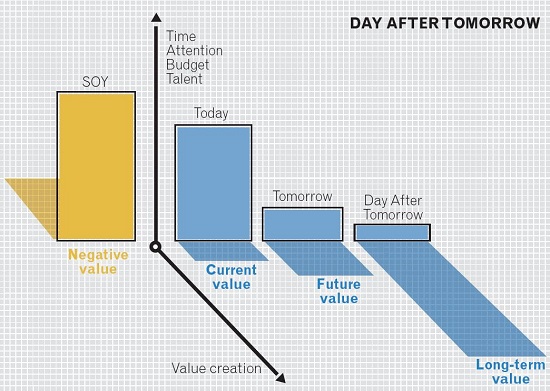
“Value Creation” The Day After Tomorrow, by Peter Hinssen (c2017).
Administrators that see themselves as “managers” focus the majority of their time and efforts on TODAY. They are fixated on the logistics of the moment. They worry about what is happening now. They put out fires. Their organizations often are well run, highly coordinated, and they feel comfortable. To be fair, strong managers reinforce an important psychological need for the people in their organization. They create the consistency and order which allows the people in their organizations to feel safe. However, they do so at a cost. The constant focus on the items of “today,” what some methodologies refer to as the “whirlwind,” requires a significant outlay of time, money and attention – an outlay that results in shockingly little return on investment for the organization. Likewise, if we carry forward the same concept to the school setting, it isn’t difficult to see that administrators focused on daily logistics create little in the way of forward progress when it comes to student learning.
However, school and district administrators who view themselves as instructional and organizational “leaders” have the ability to shift the value proposition for their organizations significantly. By focusing their time and energy on developing, articulating and leading those in their organization into a future-oriented vision for growth (the “day after tomorrow”), these leaders multiply their impact across the organization in ways that lead to exponential growth. Not only do they see improvement in overall proficiency, they experience renewal and engagement amongst their teams, and they build an adaptable organization equipped to navigate change. Put another way, “leaders” help to future-proof their organization for a rapidly changing world.
I know what you are thinking already – “Sounds nice, but this guy doesn’t understand the realities of the job. Administrators today simply don’t have the time to focus on strategic planning around a future-oriented vision.” As a principal myself, I certainly understand the day-to-day pressures we all face. However, I’d argue that we can’t afford NOT to spend time on visionary pursuits. The future of public education may well depend on it. So what do we do? Glad you asked. Below are three quick changes you can make today to position yourself to be a more effective leader.
EMBRACE THE 80/20 RULE
Also known as the Pareto Principle, the 80/20 rule is the concept that roughly 80% of outcomes result from 20% of causes. In other words, leaders need to focus their time and efforts on the small number of factors that will provide the greatest impact. Practically, I think about it this way: If someone can do something 80% as well as I can, I let them do it. Not only does it free me up to do the 20% that they can’t do (or can’t do as well), it creates ownership and shared leadership across the organization. Besides, if you have an office staff like mine – they likely manage the day-to-day better than you do anyways. Let them do it. You have other work to do.
MANAGE YOUR SCHEDULE – DON’T LET IT MANAGE YOU
If you aren’t intentional about your schedule it will quickly be filled by daily items that shouldn’t be taking up space. Every block of time spent on low level tasks is time not spent focusing on growth. Be protective of your time, and proactive about scheduling it. Make it a habit to block out 15-20% of your schedule for “big picture” planning and systemic work that will improve the organization as a whole. If you don’t schedule this time it WILL quickly get shelved in favor of the daily whirlwind of tasks demanding your attention. While you are at it, consider how email and other low-level communication impacts your workflow. Trying to respond to email and messages throughout the day is like suffering a death by a thousand cuts. Instead, schedule a block of time at the beginning or end of the day to review and respond to messages, and then do your best to ignore them the rest of the day (unless it is something truly urgent). You will be amazed by how much more time this creates in your day.
STOP LOOKING TO EDUCATORS TO INFORM YOUR VISION
I’ll be the first to admit that this is a bit of a hot take – especially coming from an educator. But just hear me out. The problem with relying on education to inform your vision is that education tends to be both very insular and backwards focused (what has/has not worked already). Both of these things are the enemy of visionary leadership. If we want to prepare kids for their future, we need immerse ourselves in the future. Business leaders, technologists, futurists and the like are all great sources for helping us understand what may be coming next so that we can BUILD the learning experience our kids deserve today. Looking for somewhere to start? Consider these titles to expand your worldview and widen your perspective on education.
- The Day After Tomorrow: How to Survive in Times of Radical Innovation, by Peter Hinssen
- The World is Faster Than You Think, by Peter Diamandis & Steven Kotler
- Adrift: America in 100 Charts, by Scott Galloway
- 21 Lessons for the 21st Century, by Noah Yuval Harari

 A.Nelson